KPI Framework for SME Strategy Execution
Many SMEs do not struggle because they lack ambition or a strategy. More often, they struggle because execution becomes uneven. Priorities are agreed, plans are set, and targets are communicated, but daily activity gradually gets pulled back into urgency, short-term problem solving, and competing demands. That is where a clear KPI framework becomes valuable.
A well-designed SME KPI framework does more than track performance. It gives leadership teams a practical way to turn strategy into action. It helps clarify what matters most, shows where progress is being made, and highlights where execution is starting to weaken before results begin to suffer.
For small and medium-sized enterprises, this is particularly important. SMEs often operate with tighter margins, leaner leadership capacity, and fewer layers of control. As a result, weak visibility and poor coordination tend to have a faster and more noticeable impact. When KPIs are poorly chosen, teams can become busy without making meaningful progress. When KPIs are well chosen, they create focus, accountability, and consistency.
The purpose of strategy execution metrics is not to create more reporting for its own sake. It is to make execution clearer, steadier, and more disciplined.
Why SMEs Need A Different KPI Approach
Many KPI models used in larger organisations are not well suited to SMEs. They are often too complex, too functionally driven, or too far removed from the realities of running a smaller business. SMEs need a framework that is more practical and more selective.
A strong KPI framework for an SME should do three things.
First, it should make strategic priorities visible. If the business says its priorities are growth, customer retention, margin improvement, operational resilience, or people capability, the framework should show whether those areas are genuinely progressing.
Second, it should support decision-making, not just reporting. A useful KPI should help leaders see where attention is needed, where risks are emerging, and where trade-offs need to be managed.
Third, it should be manageable. SMEs do not benefit from large reporting packs filled with measures that no one uses. The framework needs to be disciplined enough to focus only on what genuinely influences performance and execution.
This is why effective strategy execution metrics usually include both leading and lagging indicators. Lagging indicators show the results that have already happened, such as revenue growth, gross margin, churn, or profit. Leading indicators show whether the conditions for future performance are being built, such as proposal conversion, on-time delivery, complaint levels, employee retention, or cycle time.
Without that balance, leaders either spend too much time looking backwards or end up relying too heavily on judgement alone.
What A Practical SME KPI Framework Should Include
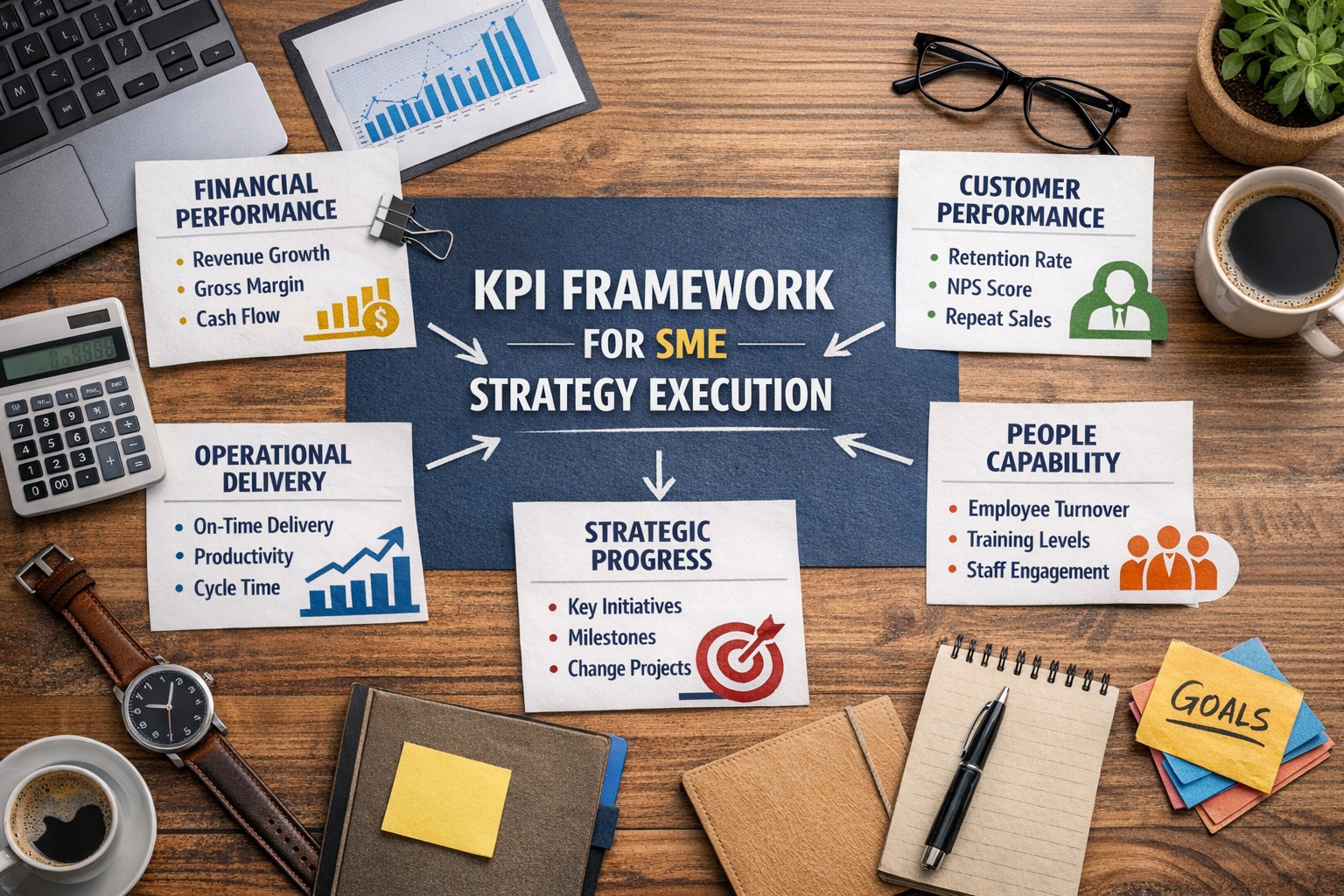
A useful SME KPI framework will usually cover five core areas:
1. Financial performance
Financial KPIs remain fundamental because strategy must eventually produce commercial outcomes. However, SMEs should avoid relying too heavily on top-line revenue alone. Revenue growth can look positive while margin quality weakens, cash pressure increases, or operational strain builds underneath it.
A better approach is to monitor a focused set of financial measures such as revenue growth, gross margin, net profit margin, cash conversion, debtor days, and average revenue per customer or account. Together, these provide a better view of whether the business is growing in a sustainable and commercially sound way.
2. Customer performance
Execution often begins to fail when organisations lose sight of the customer experience. Internally, a strategy may appear to be moving well, while externally the customer experience is becoming weaker or less consistent.
Useful customer KPIs may include retention rate, repeat purchase rate, net promoter score, complaint trends, proposal win rate, average response time, and customer lifetime value. For many SMEs, retention and conversion matter greatly because profitable growth often depends less on constant acquisition and more on improving the value of existing relationships and opportunities.
3. Operational delivery
This is the point at which strategy becomes visible in practice. Operational KPIs show whether the business is capable of turning intent into consistent delivery.
Measures in this category may include on-time delivery, order accuracy, project completion rate, cycle time, utilisation, stock availability, rework, service level attainment, or production efficiency. The exact measures will depend on the business model, but the principle is constant: if delivery is unstable, strategy will not perform as intended.
4. People capability
Many SMEs still under-measure the people side of execution. Yet execution quality is directly affected by management capability, leadership clarity, skill depth, and workforce stability.
Useful people KPIs can include employee turnover, time to competence, absence rates, engagement indicators, internal promotion rates, training completion, and management capability measures. In a smaller organisation, the effect of a few poor management decisions can be significant, so people metrics should be treated as strategically relevant rather than secondary.
5. Strategic progress
This is often the weakest area in many KPI frameworks. Businesses tend to monitor business-as-usual performance while failing to measure whether strategic change itself is actually progressing.
Strategic KPIs should track the few initiatives that matter most. These may include completion of a market entry plan, milestones in a new operating model, adoption rates for a new CRM process, reduction in decision-making cycle time, or progress within a margin improvement programme.
These are the strategy execution metrics that connect leadership intent with operational reality.
How To Build The Framework Properly
The starting point is not a list of metrics. It is strategic clarity.
Before deciding what to measure, leadership teams need to answer four questions. What are the business priorities over the next 12 to 24 months? What outcomes would define success? What behaviours or operating conditions need to be true for those outcomes to happen? Where does execution currently break down?
Once those answers are clear, KPI selection becomes more disciplined.
A useful rule is to keep the framework tight. In most SMEs, around 12 to 20 company-level KPIs is usually sufficient, supported by a smaller number of functional measures beneath them. Beyond that, focus tends to weaken and reporting becomes harder to use.
Each KPI should also have a clear owner, a precise definition, a reporting rhythm, a target, and an agreed threshold for action. If ownership is unclear, the metric drifts. If the definition is vague, interpretation varies. If there is no trigger for intervention, reporting becomes passive.
It is also helpful to group metrics into three categories,outcome metrics, performance drivers, and health indicators. Outcome metrics show the result achieved. Performance drivers show what is likely to influence those outcomes. Health indicators reveal system stress, such as rising attrition, worsening quality, or longer cycle times. That distinction improves decision-making because it helps leaders understand not just what is happening, but what is driving it.
Common Mistakes SMEs Make
One common mistake is measuring what is easy rather than what is useful. It is straightforward to count meetings booked, website visits, or activity volume. It is more valuable to measure conversion quality, delivery reliability, decision speed, or profitability by segment.
Another mistake is overloading the business with too many KPIs. More data does not automatically produce more control. In many cases, it creates confusion, weakens focus, and encourages defensive reporting.
A third mistake is failing to connect KPIs to accountability. If performance is reviewed but no action follows, the framework quickly loses credibility.
A final mistake is reviewing KPIs too mechanically. A monthly KPI discussion should not become a routine reading of numbers. It should be a leadership conversation about what is changing, why it is changing, what action is required, and what trade-offs now need to be managed. That is when a KPI framework starts to support execution rather than simply describe it.
A Simple Implementation Approach
For SMEs looking for a practical way to begin, the process can be straightforward.
Start by identifying the three to five strategic priorities that matter most over the next year. Then define the outcomes linked to each one. From there, choose a focused set of KPIs that show progress, risk, and execution quality. Assign ownership. Standardise definitions. Build a simple dashboard. Review it regularly at leadership level. Most importantly, use it to drive action.
The framework does not need to be perfect at the outset. It does need to be usable. The strongest KPI systems are usually refined over time as leadership teams learn which measures sharpen decision-making and which ones simply add noise.
Final Thought
An SME KPI framework should not be seen as an administrative exercise. It is a leadership tool. It helps translate strategy into operational discipline. It shows where delivery is slipping, where alignment is weak, and where leadership attention needs to shift.
For SMEs, that clarity can be the difference between having a strategy and actually delivering it.
When strategy execution metrics are well chosen, properly reviewed, and tied to real accountability, they do more than measure performance. They help improve it.
Book a Strategy-to-Execution Alignment Review to assess whether your priorities, governance, KPI discipline, and operating model are helping delivery or quietly holding it back. Contact Us