The 7 Layers of Strategy Execution
Executive summary
UK SMEs are the engine room of the economy, accounting for around 60% of private-sector employment and 51% of turnover. Yet many leadership teams experience the same frustration, the strategy is sensible, but operational pressure pulls the organisation back into reactive mode, and the plan does not translate into consistent delivery.
Strategy Praxis Group’s 7 Layers of Execution is a practitioner-built framework designed for SME realities, limited management bandwidth, fast context shifts, and the need to show results quickly. It turns strategy into an operating system that is explicit about prioritisation, operational commitments, ownership and decision rights, leadership conversations, a repeatable execution rhythm, and the culture required to sustain follow‑through.
This emphasis is strongly supported by evidence. UK research links more structured management practices to higher productivity, at the same time, academic strategy work repeatedly finds that formulation is not the main barrier, implementation fails when coordination, accountability and management control mechanisms are weak or inconsistent.
Why execution breaks in UK SMEs
Execution stalls in SMEs for predictable reasons. Leaders are close to the customer and the work, which improves speed, but it also concentrates decision load and increases interruption. When priorities are not explicit, urgent issues crowd out important ones, when decision rights are unclear, work slows in the grey areas between functions and when measurement is activity-based rather than outcome-based, teams stay busy without moving the business.
UK evidence reinforces why this matters. ONS work on management practices highlights the role of structured practices (including targets, monitoring, and operational improvement routines), and CIPD analysis reports materially higher productivity in firms with more structured management practices. Meanwhile, SME research cautions against treating “planning” as a magic ingredient, formal planning is not universal and is not a guaranteed route to success, the implication is practical, SMEs do not need more strategy documents, they need a better execution system.
Henry Mintzberg also warned that formal planning can obscure strategic thinking and learning if organisations confuse plans with strategy. In an SME context, that warning often shows up as “beautiful slides and uneven follow‑through”, we believe the remedy is not less ambition, it is stronger translation.
The Strategy Praxis Group 7-layer framework
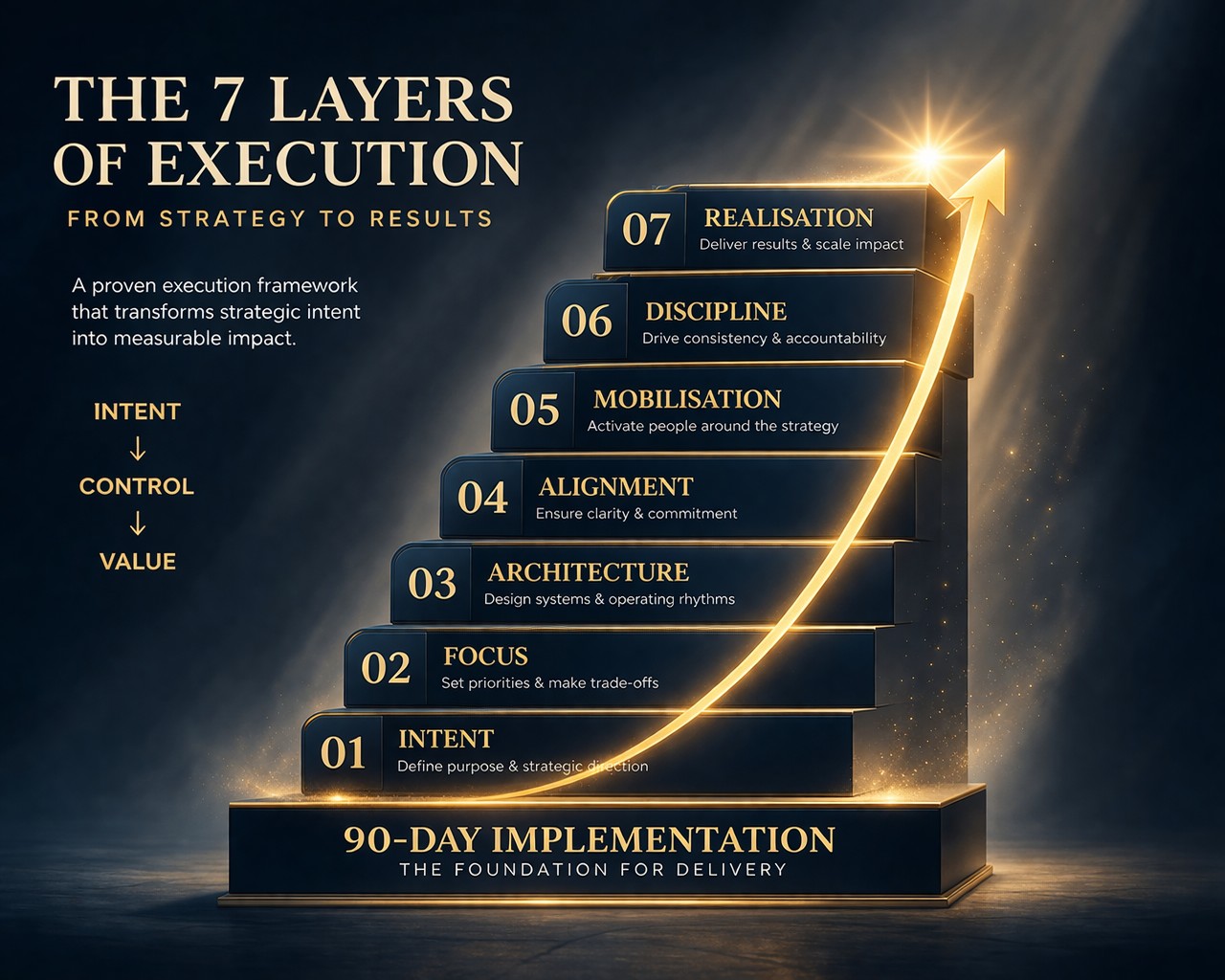
The 7 Layers of Execution map the journey from intent to sustained value. Each layer strengthens one or more of the execution levers leaders can control, prioritisation, operational commitments, ownership and decision rights, leadership conversations, execution rhythm, and culture.
Intent clarifies the few “must-win” outcomes and the value logic behind them. This is where SMEs win or lose focus, if intent is vague, execution becomes vulnerable to the loudest operational demand. Hrebiniak’s implementation research highlights how obstacles emerge when strategy is not translated into what managers must do differently.
Focus is prioritisation with trade-offs, it converts intent into a small portfolio of priorities that leadership will actively defend for the next 90 days and beyond. This is where SMEs reduce overload, if everything is a priority, nothing is. ERC evidence that planning is not consistently beneficial strengthens the case for pragmatic focus over performative planning.
Architecture establishes ownership and decision rights, one accountable owner per priority, explicit decision authority, and an escalation path. It also defines what the leadership team will review, at what cadence, and in what format. Eisenhardt’s work on fast strategic decisions shows that effective teams use more information, develop more alternatives, and integrate strategic decisions with tactical plans, that integration is easier when governance and decision rights are explicit.
Alignment ensures the organisation can actually execute, critical roles, capabilities, incentives, data, and cross-functional handovers are addressed before mobilisation. This is also where measurement is designed so the organisation can see “movement” rather than activity. Kaplan and Norton argue that what leaders measure shapes behaviour and that performance systems should link strategic outcomes with operational drivers.
Mobilisation turns commitments into sequenced delivery, a pragmatic backlog, named workstreams, and removal of the friction that typically slows SMEs (unclear priorities, unresolved dependencies, and decision bottlenecks). This is where leadership conversations must shift from updates to decisions.
Discipline is the execution rhythm, KPI-led reviews, exception-based management, rapid escalation of blockers, and benefits tracking. Evidence from UK management research supports the impact of structured practices such as monitoring, targets, and continuous improvement routines.
Realisation is value capture and cultural embedding. Results are locked in through standard work, capability transfer, and leadership expectations that survive the initial push. Kotter’s change work emphasises the need for visible wins and for anchoring new behaviours so they endure.
How to implement the 7 layers in a 90‑day cycle
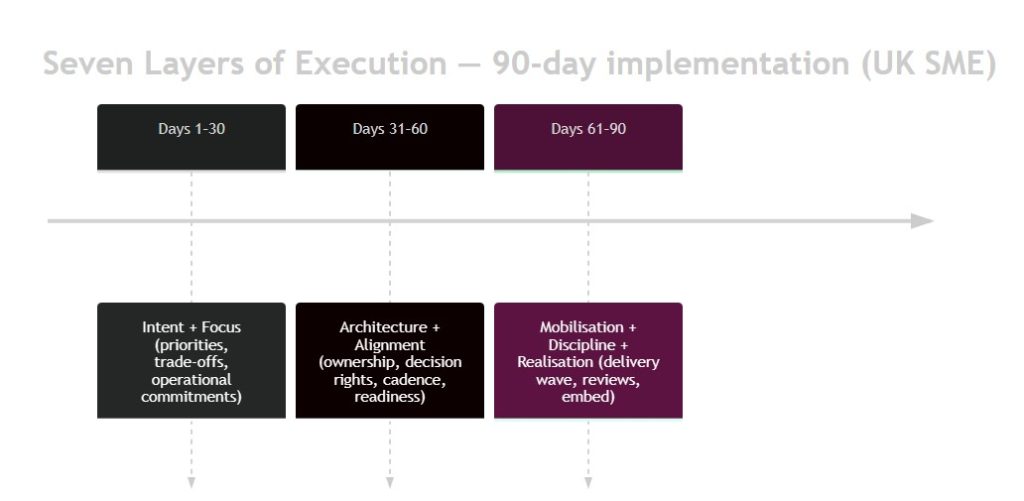
Strategy Praxis Group uses a 90‑day implementation cycle because SMEs need momentum, governance that fits limited bandwidth, and early proof that builds confidence.
Days 1–30: Intent and Focus
Confirm the value thesis, define the few priorities that matter most, and make trade-offs explicit. Translate each priority into 2–4 operational commitments (outcomes plus leading indicators). This is where measurement design matters, balanced measures prevent teams from optimising one area while degrading another.
Days 31–60: Architecture and Alignment
Assign one accountable owner per priority, clarify decision rights, and define escalation routes. Install the leadership operating rhythm (weekly blockers, monthly outcomes, quarterly recalibration). Align handovers, roles, data, and capacity to remove predictable constraints. ONS evidence on management practices underscores why routines and monitoring systems are not “bureaucracy”, they are productivity mechanisms.
Days 61–90: Mobilisation, Discipline and Realisation
Launch the first delivery wave, track outcomes weekly, and run leadership conversations as decision forums. Capture early wins, then convert them into standard ways of working (process, capability, governance) so value does not evaporate when attention shifts. Kotter’s emphasis on sustaining change through anchoring behaviours is directly relevant here.
UK SME examples with measurable outcomes
The following are anonymised UK SME examples. Metrics are illustrative composites intended to show the types of measurable shifts the framework typically targets, exact baselines and results will vary by sector, operating model, and starting maturity.
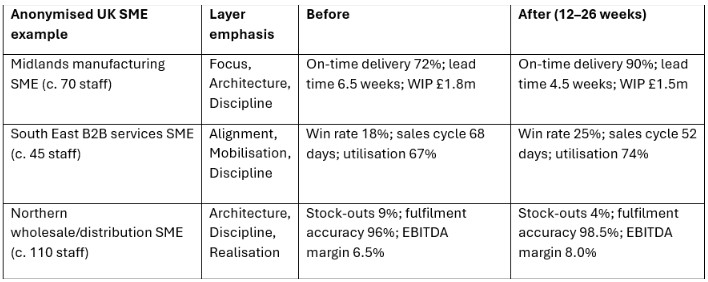
What changes across these scenarios is not effort, it is control. Priorities are narrowed, operational commitments are measurable, ownership and decision rights reduce delay, leadership conversations become decision-led, and reviews become rhythm rather than theatre. This aligns with the broader evidence base linking structured management practices to performance outcomes.
If your strategy feels sound but execution is inconsistent, the 7 Layers of Execution are designed to give your leadership team a practical operating system for delivery without importing heavyweight corporate bureaucracy into an SME. Contact Us