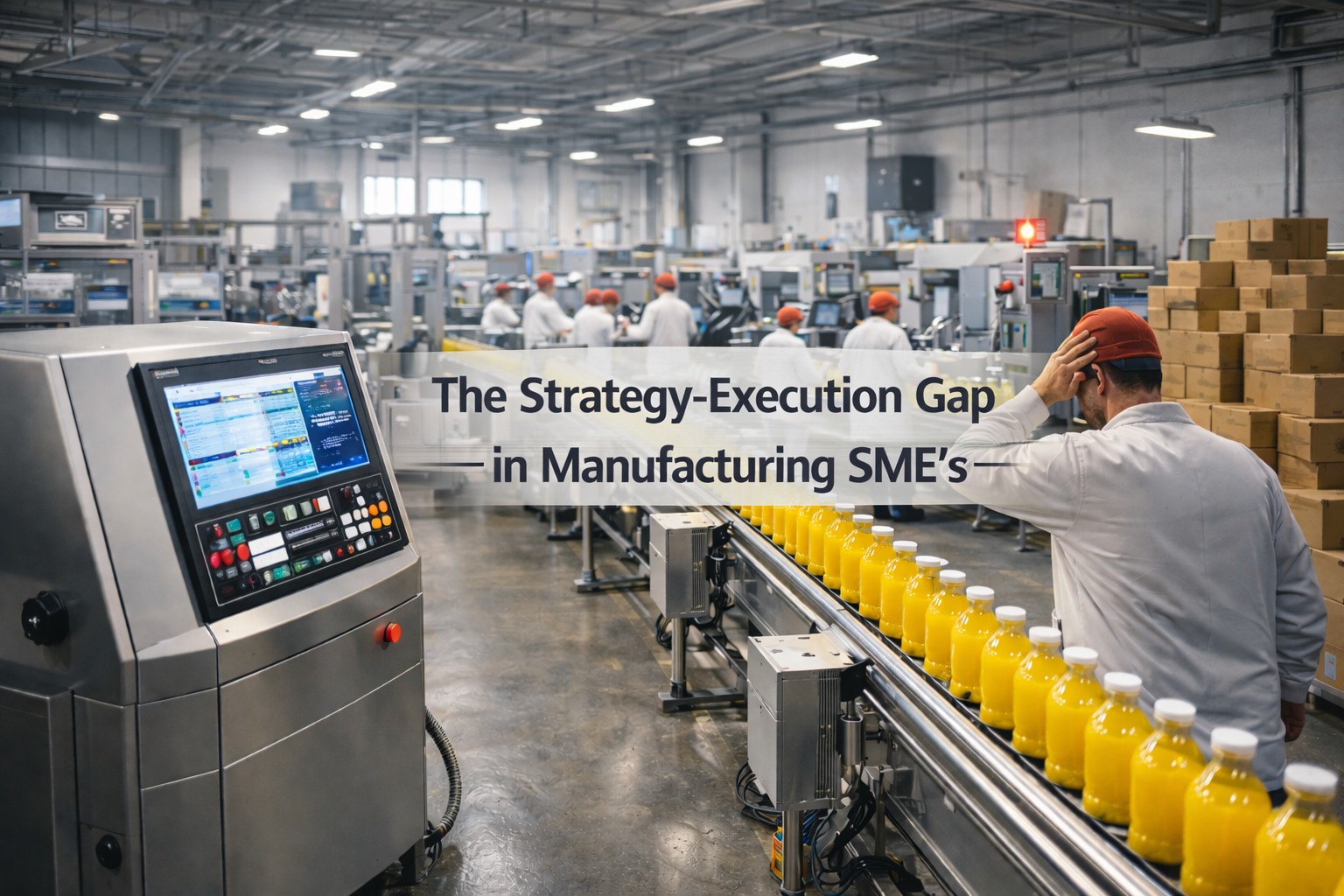
The Strategy-Execution Gap in Manufacturing SMEs
Many manufacturing SMEs do not struggle because they lack ambition. They struggle because what they want the business to achieve is often ahead of what the operation can reliably deliver.
That is the strategy-execution gap.
It shows up when growth targets look sensible in a leadership meeting, but the shop floor is already under pressure. It shows up when sales is chasing more volume, while production is dealing with labour shortages, machine downtime, supplier delays, or poor scheduling. It shows up when the business says it has a clear manufacturing strategy, but daily decisions are still driven by urgency rather than direction.
For manufacturing SMEs, this gap can do real damage, problems surface quickly,lead times slip, margins tighten, stock builds in the wrong places, critical items run short, overtime rises, forecasts become less reliable, customers lose confidence and senior leaders spend more time dealing with disruption than improving the business.
That is why manufacturing strategy execution matters. In this sector, strategy is not abstract, it lives in demand planning, capacity, labour, sourcing, inventory, production flow, and commercial discipline. When those parts do not line up, even a strong-looking plan can fail in practice.
For leaders in manufacturing SMEs, the real question is not whether the strategy sounds convincing. It is whether the business can carry it out consistently.
Why the strategy-execution gap is common in manufacturing SMEs
Manufacturing SMEs operate under pressures that many service businesses never face. They have to manage physical capacity, changing demand, supplier performance, lead times, quality, working capital, and customer commitments all at once.
That creates friction.
A business may want to grow by entering new markets, taking on larger contracts, or widening its product range. On paper, that can look commercially attractive, in reality, the operation may already be stretched. One bottleneck machine, a shortage of skilled labour, a fragile supplier base, or weak production planning can make the growth plan far harder to deliver than it first appears.
This is where many manufacturing SMEs come unstuck. They build a business strategy without fully testing it against operational reality.
The commercial team pushes for growth.
Operations tries to protect output.
Procurement focuses on cost.
Finance focuses on cash.
Each priority makes sense on its own. The problem starts when they are not connected. That is when strategy drifts and execution becomes inconsistent.
In smaller manufacturers, the issue is often made worse by limited leadership capacity. Senior people are usually close to the day-to-day running of the business. That keeps them tied to immediate problems and leaves too little time to strengthen the system behind performance.
The business stays active, but not always in control.
Why manufacturing strategy must be grounded in capacity and demand
A strong manufacturing strategy cannot sit above operations. It has to be built around them.
That starts with capacity.
Many SMEs think they understand capacity because they know headcount, machine hours, or shift patterns. Real capacity is more exact than that, it sits in the true constraint, it sits in the process, machine, skill set, or supplier dependency that limits what the business can deliver at pace and at margin.
That is where strategy either becomes real or starts to weaken.
If demand rises faster than actual capacity, service slips.
If product mix becomes more complex without proper planning, throughput slows.
If the business chases volume that does not suit its operating model, margins suffer.
This is why demand and capacity must be viewed together. Looking at one without the other leads to poor decisions. A full order book may look encouraging, but if it overwhelms the operation, it can create late deliveries, excess overtime, rework, customer dissatisfaction, and pressure on cash. Growth without control is not progress. It is strain.
Manufacturing SME leaders need to ask harder questions:
Can the operation absorb the planned mix of demand?
Where is the real production constraint?
What gives way first if demand rises?
Which customer commitments depend on fragile internal capability?
Which products or customers create the most pressure for the least return?
These are not just operational questions. They sit at the centre of strategy.
Supply chain is not support work. It is part of strategy.
One of the biggest mistakes in manufacturing SMEs is to treat supply chain as a buying function rather than a strategic one.
That no longer works.
Supplier reliability, lead-time stability, sourcing concentration, inventory policy, inbound risk, transport dependency, and materials availability all shape whether the strategy can be delivered. In manufacturing, supply chain does not sit on the side of the business model. It sits inside it.
If a business depends too heavily on one supplier, one region, or one critical material with a long replenishment time, the strategy already carries risk. If stock is too lean, service can fail. If stock is too high, cash gets trapped. If procurement focuses only on lowest cost without understanding production risk, instability usually follows.
The strongest manufacturing SMEs are more deliberate here. They do not only ask how to buy cheaper. They ask how to source more reliably, plan with more discipline, and protect delivery without weakening cash flow.
That is a stronger form of manufacturing strategy execution.
Where the execution gap usually opens up
In many manufacturing SMEs, the gap opens in five familiar places.
The first is weak translation from commercial ambition into operational requirements. Leaders set growth targets, but do not define what those targets mean for labour, machinery, scheduling, inventory, or supplier readiness.
The second is poor planning discipline. Forecasts are weak, priorities change too often, and operations is left reacting to late decisions rather than working to a stable flow.
The third is lack of visibility. The leadership team sees headline numbers, but not the early signs that execution is coming under pressure.
The fourth is functional tension. Sales, operations, procurement, and finance are all trying to optimise different things, without a clear view of the trade-offs across the business.
The fifth is leadership overload. Senior people spend too much time unblocking urgent issues and too little time improving the operating system itself.
When these conditions come together, the business becomes reactive. It may still perform for a period, especially when demand is healthy, but weakness builds underneath.
The manufacturing SME KPIs that actually matter
This is where better measurement helps.
Too many manufacturing SMEs track familiar operational numbers without linking them to strategic execution. They monitor output, scrap, and on-time delivery, but still miss the wider picture.
The most useful manufacturing SME KPIs usually sit in five groups.
1. Demand quality KPIs
These show whether growth is healthy, not simply whether orders are arriving.
Useful measures include forecast accuracy, order mix, margin by customer or product group, quote-to-order conversion, revenue concentration, and backlog quality.
A large order book is not always a strong one. Leadership teams need to know whether they are winning the right work.
2. Capacity and flow KPIs
These show whether the operation can absorb demand.
Useful measures include bottleneck utilisation, schedule adherence, labour productivity, planned versus actual throughput, changeover performance, overtime dependency, and backlog ageing.
Looking at total capacity in the round often hides the real issue. The real issue usually sits at the point of constraint.
3. Supply chain performance KPIs
These show whether inbound risk is starting to weaken execution.
Useful measures include supplier on-time delivery, lead-time variability, shortage frequency, expedite rates, inventory turns, stock cover, and single-source exposure.
If the business cannot see supplier risk early, it usually pays for it later through disruption, delay, or working-capital pressure.
4. Quality and delivery KPIs
These show how well execution is holding together.
Useful measures include first-pass yield, rework cost, customer complaints, returns, late-order root causes, and delivery-in-full-on-time.
Quality issues are often execution issues in another form. They can point to overloaded systems, unstable processes, or weak planning.
5. Cash and commercial discipline KPIs
These show whether the strategy remains financially sound.
Useful measures include operating cash conversion, debtor days, days inventory outstanding, gross margin leakage, and the cost of expedite, scrap, or excessive overtime.
In manufacturing SMEs, poor execution often shows up in cash before it becomes obvious elsewhere.
What strong execution looks like in practice
Manufacturing SMEs that execute well tend to do a few things differently:
They line up sales ambition with real production capacity.
They treat supply chain design as part of strategic planning.
They focus on the true operational constraint rather than broad averages.
They use KPIs as an early warning system rather than a reporting routine.
They make clearer trade-off decisions between service, stock, cash, and margin.
They protect leadership time for cross-functional review, rather than allowing it to be swallowed by daily disruption.
Most importantly, they do not confuse activity with progress.
A factory can be busy and still underperform. A leadership team can work hard and still be pulling in different directions. Strong execution comes from system discipline, not from effort alone.
What SME leaders should do next
For manufacturing SME leaders, the practical next step is not to write a longer strategy document. It is to test whether the current strategy can actually be delivered.
Take one major growth objective and run it through the business:
What does it mean for demand planning?
What does it mean for production capacity?
What does it mean for labour and skills?
What does it mean for supplier resilience?
What does it mean for inventory and working capital?
What does it mean for service risk and customer retention?
Where that chain breaks, the execution gap is already visible.
That is where leadership attention should go.
Final thought
The strategy-execution gap in manufacturing SMEs is rarely caused by weak intent. More often, it comes from weak translation. The business knows what it wants, but has not properly aligned demand, capacity, supply chain, and leadership focus behind it.
That is why manufacturing strategy execution matters.
The manufacturers that perform best are usually not the ones with the most complicated plans. They are the ones that understand their constraints, track the right manufacturing SME KPIs, connect supply chain decisions to business strategy, and act early when execution starts to drift.
For manufacturing SMEs, that is the difference between having a strategy and having one that works. For more Contact Us